
- Erlang allows you to create highly scalable concurrent systems without affecting performance.
- It supports hot code updates and robust fault tolerance.
- It is designed for distributed environments, ideal for telecommunications and critical systems.
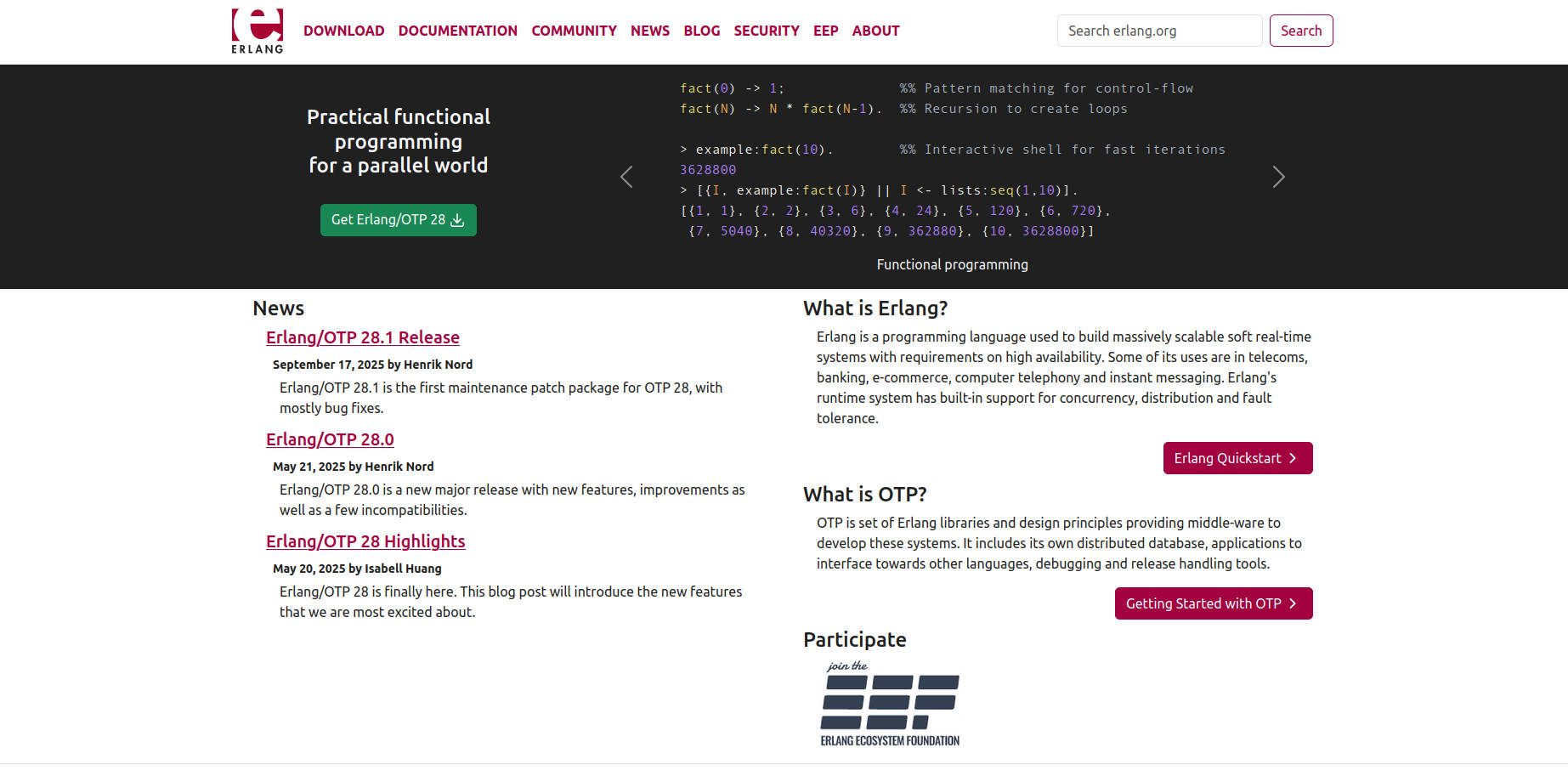
Erlang It's not a new language, but it continues to generate interest among developers looking to create distributed, scalable, and highly available applications. Although it originated in the 80s, it remains very prevalent in sectors such as telecommunications, instant messaging, and NoSQL databases.
In this article we're going to take an in-depth look at all the features that make Erlang, a different languagewith capabilities that are still difficult for more recent technologies to match. We will explore its history, its philosophy, its inner workings, and its real-world use cases.
A bit of history: Erlang and its origins in telecommunications
Erlang was created in Ericsson's laboratories in the 1980s. The company was looking for a language that could meet the challenges of real-time communication, offering reliability, scalability, and flexibility for changes without requiring system downtime. After analyzing more than 300 languages of the time, they selected key elements from languages such as Lisp, Haskell, and Prolog to develop a functional, declarative language with a focus on concurrency. In 1998, Ericsson released Erlang under an open-source licensewhich significantly helped its adoption in other industries.
What makes it unique compared to other languages?
Erlang is specifically designed for concurrent and distributed systemsIts great strength lies in the processes it manages, which are extremely lightweight and whose creation or destruction consumes hardly any resources. Each process in Erlang is completely isolated and communicates with other processes using asynchronous messages..
Instead of using operating system threads, as is common in other languages, Erlang manages its own processes within its virtual machine (BEAM)which gives it a full control over concurrency and fault toleranceThis means that a process can fail without affecting the integrity of the system, since other processes monitor its state and can restart it automatically.
Erlang and fault tolerance: a different approach
Robustness is one of the fundamental pillars of ErlangIt has built-in mechanisms to detect faults and act accordingly, enabling an architecture where errors are not hidden but managed through supervisory processes. This strategy, known as 'fail-fast' or 'let it die', simplifies error control and allows for the construction of highly maintainable systems.
Thanks to this architecture, systems developed in Erlang are prepared to automatically recover from serious failures, including the death of entire processes or even the failure of nodes in distributed systems.
Distributed and scalable systems
One of Erlang's greatest strengths is its ability to build distributed systems natively.An Erlang system can be composed of multiple nodes running on different machines—even different operating systems—but communicating internally as if they were on a single node.
This structure greatly facilitates horizontal scalability, as it allows workloads to be distributed and tasks to be performed in parallel without worrying about the complexity of the underlying distributed environment. Erlang abstracts everything with a clear set of primitives.
Functional and declarative programming
In Erlang, code is organized into modules with pure functions, making intensive use of techniques such as pattern matching to control the flow of data. This helps in writing code clean, expressive and easy to reasonavoiding side effects.
Values are assigned only once to each variable (single assignment), which It eliminates many of the problems associated with mutability and shared states between processes., proving fundamental in concurrent systems.
Hot code update
A key differentiating feature of Erlang is the ability to update code on the fly without restarting the application.This allows patches to be applied or new features introduced in real time without affecting users or halting system operation. During the transition, the system can run both the new and old code until the migration is complete safely.
This mechanism is key in environments where continuous availability is a priority, such as financial systems, telecommunications networks, or instant messaging services.
Soft Real-Time
Although it is not a general-purpose language for strict real-time systems, Erlang provides fairly tight response time guaranteesIt is especially effective in systems that require reaction times on the order of milliseconds. That's why many applications that depend on a smooth user experience use it to control latency.
Erlang code examples
To illustrate what the code looks like in Erlang, here's a classic example of calculating a factorial and a sorting function with Quicksort:
-module(math). -export([factorial/1]). factorial(0) -> 1; factorial(N) when N > 0 -> N * factorial(N-1).
Regarding list comprehensions, a very powerful technique in Erlang:
[X * 2 || X <- [1,2,3,4]].
This returns a list with the duplicate elements: [2,4,6,8].
Erlang and its ecosystem: OTP and tools
OTP (Open Telecom Platform) It's much more than a telecommunications platform. It's a set of libraries, patterns, and principles for designing resilient and organized applications in Erlang. OTP includes structures like supervisors, process trees, and gen_servers, which simplify the creation and management of concurrent applications.
Within the ecosystem, you will find tools such as:
- Mnesia: a distributed, object-oriented database that is part of the OTP core.
- Rabbit MQ: a popular message queuing system written in Erlang. Official website at rabbitmq.com.
- CouchDBA NoSQL document database based on Erlang. Learn more at couchdb.apache.org.
Real-world applications developed in Erlang
Several well-known projects are built with Erlang:
- ejabberd: secure and scalable XMPP messaging server.
- Wings 3D3D modeling software.
- Rabbit MQ: queue-based message management system.
- CouchDB: distributed document database.
Web development and related frameworks
In addition to its use in telecommunications, Erlang can also be used to build web applications. Frameworks like N2O (a WebSocket server + web framework) and Nitro They allow the creation of real-time interfaces with a reactive architecture and without the need for client-side processing.
Likewise, languages such as Elixir, which run on the Erlang virtual machine, inherit all its advantages but with a more modern and user-friendly syntax.
Installation and tools
Erlang is available for multiple platforms, including Windows, Linux and macOS.
You can install it via pre-compiled packages, using managers like Homebrew or APT, or directly from the source codeThere are also plugins and extensions for working in environments like IntelliJ IDEA or Visual Studio Code thanks to Erlang LS.
Some key ideas for developers who are starting out with Erlang
- Processes are the basic unit of execution and do not share memory.
- Communications are done through the passing of asynchronous messages.
- Flow control is based on coupling of patterns and functional structures.
- It is ideal for systems where errors need to be isolated and managed without interrupting the system.
As you see, Erlang remains a fundamental language for those who need to build highly reliable distributed servicesFault tolerance and immediate response to millions of simultaneous transactions or operations. Although it's not the most beginner-friendly language for those accustomed to imperative paradigms, its functional model designed for concurrency has allowed it to remain a modern option in the era of cloud computing and distributed microarchitecture.

Experts in software, development, and applications for industry and home use. We love leveraging the full potential of any software, program, app, tool, and operating system on the market.